The awesome international Linux homepage is now available in Arabic, Russian, Vietnamese and Ukrainian!
- Check the official announcement.
- Are you missing your language? Translate it and help us promote freedomware!
The awesome international Linux homepage is now available in Arabic, Russian, Vietnamese and Ukrainian!
I’ve had the great pleasure of being invited by the TurboGears team to become an official committer for the great TurboGears framework.
This is because I’ve been contributing patches for TurboGears 2 and other packages used by Animador (a TurboGears 2 application), since I started its development, in order to fix bugs and/or add new features that I want in Animador. So now I can apply my changes by myself! 😉
And stay tunned, because very soon it’s going to be very easy to add OpenId support to any WSGI application by means of a plugin for the framework-independent repoze.who package!
GNU/Linux Matters is looking for Python developers to develop the upcoming multicultural SpreadFirefox.com-like platform to promote freedomware and Linux.
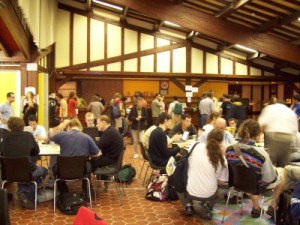
After 6 days of delicious pains au chocolat, spreading the word about GLM (by means of a conference and a booth) and having fun with cool people, I’m back home in Madrid from the RMLL.
We need people to bring the first GNU/Linux website that doesn’t suck to all possible languages.
Until last year, translations were hard to setup and manage, so we created an special multi-website CMS focused on internationalization, which makes it really easy for translators to preview their work and release websites with a few clicks, and also reports any mistake translators and editors have made (if any), among other things. We also setup a web-based translation interface, for those who don’t want to use the traditional, not-so-easy-to-use CAT applications.
The Castilian and French translations were the first to be ported to the new system, and now the Catalan translation is near completion. But the German translation is just ~60% translated, which means the new edition cannot be released the new way; this has caused some problems since we’re using the new system, because we have to maintain it the old way and the time we spend maintaining one outdated site could be used to improve the system that powers the other websites, so we decided to move on and stop maintaining it the old way – that means that it won’t be linked to from the upgraded websites such as ObtengaLinux.org, until the German translation is complete.
So, if you’re a German speaker, please help us out. But if you speak a language other than German and English, you can help too. Just head on to the GLM website to find out how to be a translator.
PS: We already talked about this on the blog, but only Catalan translators came up. I’m making another try on my blog because I belong to some groups at Mugshot and thus more people can know about this.
Just a quick post to highlight a new feature in Poliglota:
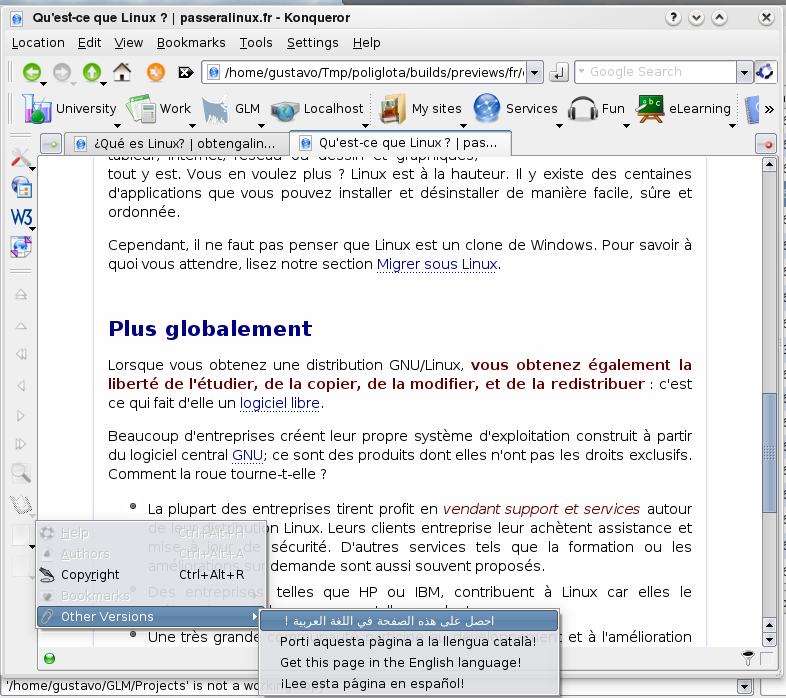
While most CMSs around have a lot of trouble with non-Western languages and cross-linking the different language editions accordingly, Poliglota has a solid support for these features since day one! And it’s just one of the features.
By the way, want to get involved and speak PHP? Then please contact us!
I’ve been assessing the possibility of switching GNU/Linux Matters‘ servers (which are all powered by Debian) to Ubuntu, and I have finally decided to go for it.
They were running Debian for three reasons:

And they weren’t running Ubuntu because, to be honest, I didn’t find Ubuntu reliable enough to power a server, mainly because of the cutting-edge applications it includes by default; it was just great for my personal computer. I guess this is mostly due to I’ve been using Kubuntu since Breeze, and it was a highly unreliable system in the early versions – IMHO things begun to take shape in Feisty and now Hardy just rocks.
I’ve started to switch our servers to Ubuntu because I think it’s the best choice, at least for us, because we still have the three advantages of using Debian (it’s based on it after all), plus:
The migration should take some months because it’s not a top-priority at present. There are many more things that should be done first.
Put simply, it’s not that Ubuntu is much better than Debian on the server, it just happens to make your job easier if you’re the administrator.
I’ve spent a lot of time trying to record some screencasts for GLM, but every screencasting software I tried crashed under Ubuntu Hardy (and Gutsy too):
So, the only solution is to install a newer version of Istanbul for Debian:
http://ftp.fr.debian.org/debian/pool/main/i/istanbul/istanbul_0.2.2-4_i386.deb
or, if you have a 64-bit box, http://ftp.fr.debian.org/debian/pool/main/i/istanbul/istanbul_0.2.2-4_amd64.deb
After making the appropriate bug reports, I can finally start recording the screencasts with Istanbul!
PS: Forget about the above. That Debian package doesn’t work either. I’m installing KDE4 to check whether I can record the screencast with it; I think I saw such an option when I tried it out.
PPS: The KDE4 built-in screencasting component uses a weird format (cps?) which cannot be opened with VLC, Mplayer nor Kaffeine (but there’s a dirty workaround). Anyways, it records the whole screen and I just want to record a single window.
PPPS: I’m not alone.
We freedomware advocates think that switching to a Freedom-respectful operating system (usually GNU/Linux) is the most important step when switching to freedomware, and therefore we focus on promoting these systems (myself included). However, I’ve found out that it does not matter that much.
The first and most important step when switching to Freedomware is using formats and protocols defined as Open Standards, even under a Freedom-trampling system like Windows: Vendor lock-in is only possible by means of closed standards. They are the stone corner of the non-free software industry.
Why those who know about Freedomware, and support the idea, don’t make the switch? Aside their inability to follow their thoughts (the games excuse is included here), because switching from Windows+Office+MSNMessenger/Etc to GNU/Linux+OpenOffice.org+Pidgin+Etc seems like a huge step, only made by adventurous souls.
The most important things for them, their information and communications, are already locked-in, tied to a single vendor. Encouraging them to switch to a freedom-respectful operating system is an unwise recommendation, if you know they still rely on closed standards:
The only way to make safely the switch to a Freedom-respectful computing environment, with no turning back, is by getting rid of closed formats and protocols, before switching to a free operating system. Windows-GNU/Linux dual boots wouldn’t be necessary anymore.
These closed standards have always been a top-priority for non-free software vendors, unlike for us. Closed standards represent the Achilles’ heel of the non-free software industry. We must hit them there! Pay attention to this excerpt from a memo sent by Aaron Contorer, Microsoft general manager for C++ development, to Bill Gates:
“The Windows API is so broad, so deep, and so functional that most ISVs would be crazy not to use it. And it is so deeply embedded in the source code of many Windows apps that there is a huge switching cost to using a different operating system instead…
“It is this switching cost that has given the customers the patience to stick with Windows through all our mistakes, our buggy drivers, our high TCO, our lack of a sexy vision at times, and many other difficulties […] Customers constantly evaluate other desktop platforms, [but] it would be so much work to move over that they hope we just improve Windows rather than force them to move.
“In short, without this exclusive franchise called the Windows API, we would have been dead a long time ago.”
We must put more effort into making people switch to open formats and open protocols, than the effort we put into encouraging them to switch to a freedom-respectful operating system like GNU/Linux. This is, our goal should be that people will get rid of closed formats and protocols before switching to a free operating system. Don’t expect them to make the switch after installing the free system! Or at least don’t get your hopes up if you ignore this (take the longer yet save path!).
The above might seem obvious to you at this point, and you might wonder, how are we supposed to do so effectively?
We have to carry out three tasks to reach our goal:
(Notice that nowadays most of us start with task #3, then some of us go further and make #1, but nearly we all forget about task #2)
These tasks should be performed separately and harmoniously, with one project for each of them. The good news is that we won’t have to start from scratch, as there are some existing efforts: GNU/Linux Matters is going to develop Unconstrained.info, a project that would meet the requirements of task #1, and it also maintains GetGNULinux.org, the project that already meets the requirements of task #3.
The second task is by far the hardest one. The solution, in my opinion, is a software suite made up of the following well-integrated modules:
This suite must meet these requirements:
Once Unconstrained.info and the liberation suite are ready, together with GetGNULinux.org, the final touch for us to be effective will be Animador.
… Organizations such as Mozilla, the FSF and the FFII will support GNU/Linux Matters with tasks #1 and #3, and the GNU project will take over task #2, with the support of all of us.
If everything fails, I’ll try my best to take over task #2 on behalf of GNU/Linux Matters.
… I’ll try to make GNU/Linux Matters change its vision, according to this blog post.
… This all sounds so beautiful, right? Well, we need you! And please don’t forget to comment on this blog post and spread the word about it if you find it useful.
PS: Got something to say? Talk about it on NXFD!
Well, it looks like I finally got a blog!
I will use it to talk about what’s going on behind-the-scenes with my contributions to the free software movement, mainly by means of GNU/Linux Matters. I want to let people know that we’re alive! That behind those cool but static websites there are people moving forward, getting ready to effectively defend Freedom in computing. Yes, we already have a blog, but I believe that a personal touch would be great as well. I look forward to seeing more people at GLM blogging about what’s happening under the hood.
But that’s not it. I’m studying computing, so you might think that I’ll blog about computing-related stuff; if so, you’re right. I love software and I wish I could only care about it, without worrying about whether it’s free or not… Every single piece of software must be free as in Freedom. Unfortunately, in the real world, most computing systems are powered by privative software.
I hope you enjoy it!
PS: You might wonder what’s “privative software”. I’ll explain it later, but in the mean time you can read dylunio’s brief explanation.

